 The Illusion of Consent: Why 'I Agree' Fails to Protect African Users in the Era of Generative AI.
28 September 2026
Data Ecosystem and Policy
abena-agyeiwaa
Digital RightsData PrivacyGenerative AIConsent FatigueAI GovernancePolicy
The Illusion of Consent: Why 'I Agree' Fails to Protect African Users in the Era of Generative AI.
28 September 2026
Data Ecosystem and Policy
abena-agyeiwaa
Digital RightsData PrivacyGenerative AIConsent FatigueAI GovernancePolicy

The Illusion of Consent: Why 'I Agree' Fails to Protect African Users in the Era of Generative AI.
The traditional 'I Agree' button is broken in the age of generative AI. We explore 'consent fatigue,' how machine learning weaponizes ordinary data for high-stakes predictions, and why Africa must shift toward strict corporate accountability and 'privacy-by-default' to combat predatory platforms.
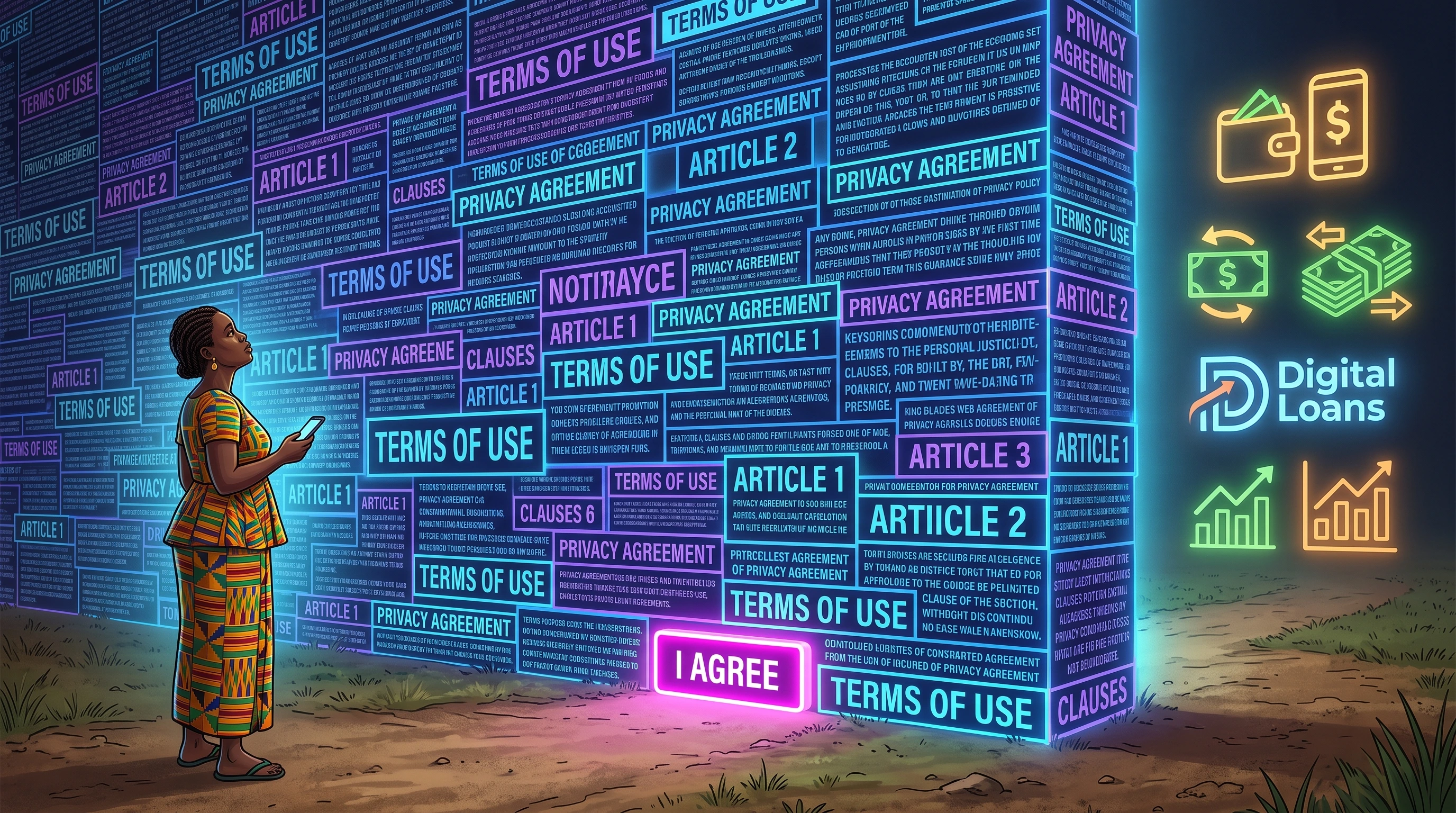
Be honest. When was the last time you actually read the Terms and Conditions before clicking “I Agree”?
Never, right? Well, congratulations. You are not alone.
Most of us have done it. Even recently, I downloaded an app, saw a wall of tiny text, scrolled past it down to the last bit and hit “I Agree” even though I didn’t know exactly what I was agreeing to. I just wanted to use the app and get on with my life. Nobody has time to read 30 pages of legal language before using an app, ordering food or applying for a loan.
And tech companies know this.
That little “I Agree” button may look harmless, but it has become one of the biggest illusions in the digital world: the idea that we are in control of our data simply because we were given a choice.
But what kind of choice is it when the options are basically “agree or don’t use the service”? That is not much of a choice.
Now add artificial intelligence to the picture and the problem gets even bigger.
Your data is no longer just being collected and stored. AI systems can take hundreds of small pieces of information, connect them, spot patterns and make predictions about you.
Something as ordinary as your online activity can potentially be used to make guesses about your interests, behavior, finances or even whether you might be a good candidate for a loan.
And here is the uncomfortable part: you may have agreed to give the company your data without ever agreeing to what AI eventually does with it.
That is where the old “I Agree” model starts to fall apart.
We are tired of clicking “I Agree”
Think about how many times you have been asked to accept something online this week. Cookies. Privacy policies. App permissions. Terms and Conditions. Location access. Contacts. Notifications. The list never ends. Eventually, people stop reading.
This is what researchers and regulators call consent fatigue.
In simple terms, we get tired of making privacy decisions.
And honestly, can we blame people?
If every app gives you another 20-page document written in language that sounds like it was designed to put you to sleep, most people will do what they need to do to get past the screen. Click. Agree. Next.
The problem is that the system can then turn that click into evidence that you knowingly accepted everything that followed.
That is where the “consent” starts looking less like protection and more like a corporate safety net.
The company can say, “But the user agreed.” The user says, “I didn’t know my information could be used for that.” And the checkbox sits quietly between them. But did we really consent?
Real consent should mean that you understand what you are agreeing to and that you have a genuine choice.
That gets complicated when a digital service says: accept these terms or leave.
Imagine needing a digital loan and being presented with a long list of permissions before you can access the money. You need the loan. You probably do not have a lawyer sitting next to you explaining every line. So you click “Agree”. Can we honestly call that informed consent?
This is particularly important in Africa, where digital services are becoming part of everyday survival, not just entertainment.
Mobile money can be essential.
Digital credit can be a lifeline.
Online platforms can be necessary for work, school and business.
When access to these services depends on accepting whatever terms a company puts in front of you, the power is not equally shared.
The company has the service.
The consumer needs the service.
And suddenly, “you are free to say no” does not sound quite so convincing.
AI has changed the game
The bigger problem is that AI can do things with data that users may never have imagined when they clicked “Agree”.
Let’s say you give an app some basic information about yourself. On its own, each piece of information may seem harmless. But AI can connect different pieces of information and look for patterns.
It can take information that seems ordinary and use it to make a prediction that is anything but ordinary.
That prediction could potentially affect whether someone gets a loan, sees a job advertisement or receives a particular offer. And you might never see the calculation happening behind the scenes.
This is why telling people to “just read the privacy policy” is not enough.
How can an ordinary person consent to something they cannot reasonably predict?
You cannot expect someone to read a privacy policy today and somehow understand every possible use of their data five years from now.
AI changes what data can reveal.
That means privacy protection has to change too and Africa cannot be an afterthought. Infact, this conversation matters even more in Africa. African users are not just consumers of technology. We are also producing data that helps build it.
Our languages, voices, images, writing, cultural knowledge and online behavior can all become part of the enormous pool of information used to develop AI systems.
But who decides how that information is collected? Who benefits from it?
And what happens when African data leaves the continent and is processed by companies thousands of kilometres away?
These are not futuristic questions.
They are questions about power.
And Ghana is already having to confront some of them. Ghana’s Data Protection Act, 2012 gave the country an important legal foundation for protecting personal information. The Data Protection Commission also has rules around issues such as transparency, data minimisation and accountability.
But AI is moving quickly. The government is now working on new data-protection legislation that is expected to address newer issues, including artificial intelligence and automated decision-making. That is a good step.
But the bigger question is whether we are still trying to solve a 2026 problem with a system that expects ordinary people to protect themselves by reading privacy policies.
Stop putting all the responsibility on the user. This is where the conversation needs to change.
Consent still matters. People should have a say in what happens to their personal information. But clicking “I Agree” cannot be the beginning and end of privacy protection.
Companies should have responsibilities too. If a platform collects too much information, it should have to explain why. If it uses AI to make decisions that can seriously affect someone’s life, there should be safeguards. If the system produces unfair results, the company should not be able to point at a checkbox and say, “Well, you agreed.”
That is what privacy-by-default should mean. You should not have to dig through ten different settings just to stop an app from collecting information it never really needed. The safest option should already be the default.
And that brings us back to the little button we started with, “I Agree” should not mean “I accept everything”.The biggest mistake we can make is blaming ordinary people for clicking “I Agree”.
People are not careless because they do not read 50-page privacy policies.
The system is designed in a way that makes reading them unrealistic.
The real question is why we have built a digital economy that expects ordinary people to defend their privacy against companies with teams of lawyers, engineers and data scientists.
That is not a fair fight.
If AI is powerful enough to make decisions about people, then the companies building and using these systems should be powerful enough and responsible enough to protect those people.
Africa does not need more complicated consent buttons. We need stronger rules.We need regulators who can keep up with AI. We need companies that are held responsible for what their systems actually do, not just what their privacy policies say they do.
And we need a digital world where saying “no” does not mean being locked out of essential services.Because clicking “I Agree” does not automatically mean we understood what we agreed to.
Sometimes it simply means we just wanted to use the app.
And those are two very different things.
Key Takeaways
- The "I Agree" Button is a Corporate Shield: It transfers legal liability from the platform to the user, weaponizing "consent fatigue" to create an illusion of control.
- AI Renders Traditional Consent Meaningless: Machine learning algorithms use seemingly harmless data to make high-stakes, unpredictable predictions, invalidating original user consent.
- Governance Must Shift to Accountability: To protect users from predatory apps and digital neo-colonialism, lawmakers must mandate "privacy-by-default" and strict corporate liability.