 What People Really Think AI Is
25 May 2026
AI in Everyday Contexts
emmanuella-ellie
AI PerceptionPublic TrustData SovereigntyDigital DivideAI LiteracyLocal DataFuture of Work
What People Really Think AI Is
25 May 2026
AI in Everyday Contexts
emmanuella-ellie
AI PerceptionPublic TrustData SovereigntyDigital DivideAI LiteracyLocal DataFuture of Work

What People Really Think AI Is
Across Africa, conversations about AI reveal a complex patchwork of hope and fear. While urban innovators see a pathway to economic leapfrogging, rural communities worry about job displacement, cultural erasure, and Western bias. We explore the critical perception divide, the danger of the '2% data deficit', and why Africa's AI future ultimately depends on earning the public's trust.
Across the bustling streets of Accra and Kumasi in Ghana, or in townships around Johannesburg, conversations about artificial intelligence (AI) reveal a patchwork of hope, fear, confusion, and curiosity.
For many, AI is not an abstract technological marvel. It is something tied to immediate realities: jobs that might vanish, health diagnoses that could save lives, languages that risk being forgotten, or deep-fake videos that blur truth during elections.
These perceptions are shaped by limited exposure, cultural contexts, and global hype. They profoundly influence whether AI will be embraced, adapted, or resisted across Africa.
Why perceptions of AI differ
In Ghana, a 2024 documentary, AI: Saving Lives and Languages in Ghana, captured street-level sentiments. Many Ghanaians expressed skepticism. The World Risk Poll showed that 47% believed AI would do more harm than good over the next 20 years. Only 28% saw it as helpful.
What ordinary people are saying
Listening to those conversations in Accra, Kumasi, Johannesburg, and beyond may be the most important step toward building AI systems that Africans trust and shape for themselves.
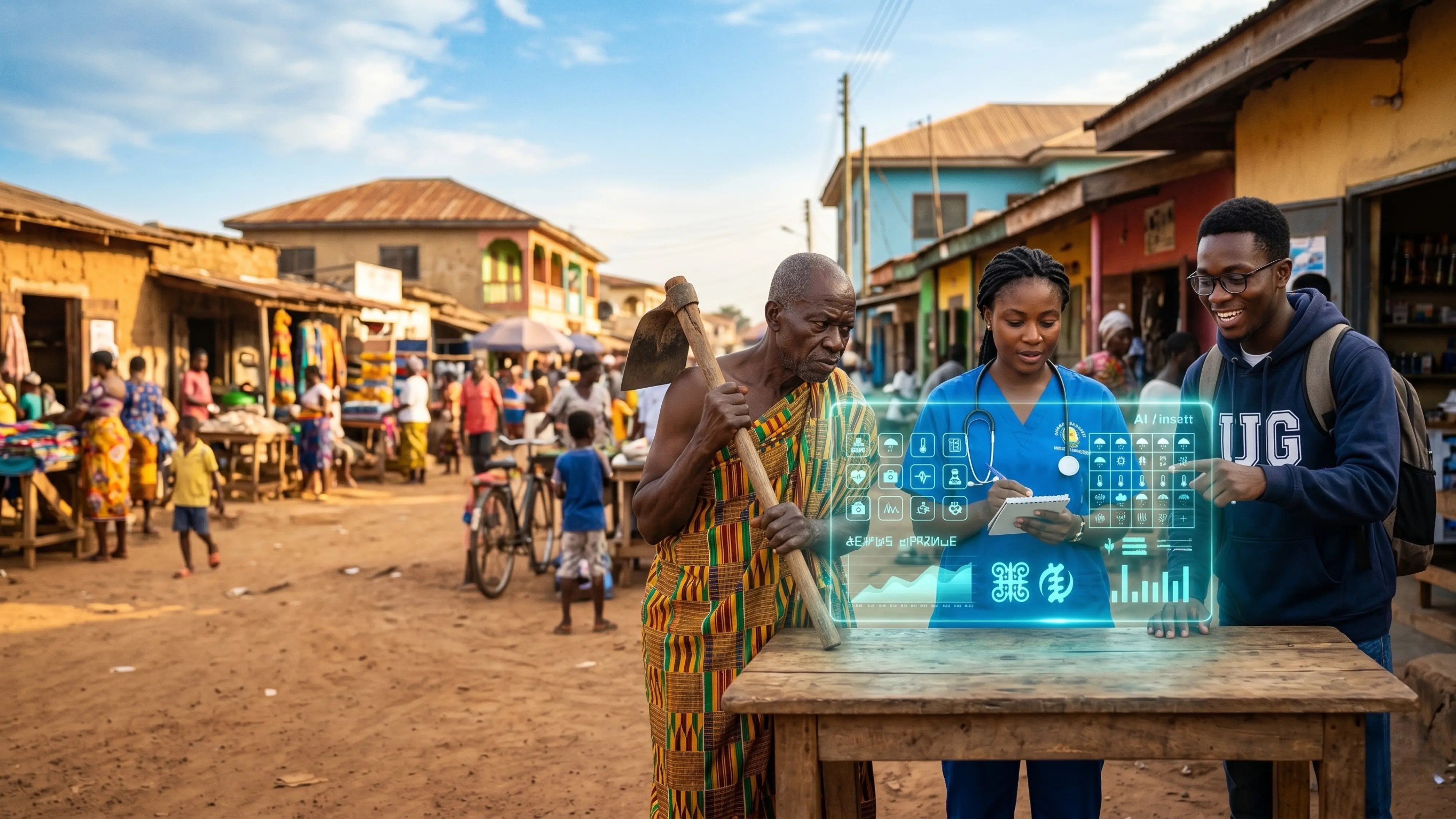
“I think AI can help us with farming by telling us when to plant and what pests are coming. But will the machine take my job at the end of the day? That scares me.” Kwame, smallholder farmer near Kumasi shared his fear.
“AI is like a smart doctor that never gets tired. In our clinic, it helps read scans faster so patients don’t wait long. We still need real doctors for the talking part.” Ama, a nurse explained.
“ChatGPT helps me write essays, but sometimes it doesn’t understand Ghanaian context or our history. We must train it with our own data or it will teach wrong things.” Yaw, university student at KNUST said.
Fear, hope and miscommunication
Many people worry about job losses and uncertain future uses. This is especially true in agriculture, where farming remains a backbone for millions.
Yet AI has many positive applications. For example, AI tools from MinoHealth AI Labs speed up medical screenings in resource-strapped clinics. Other projects preserve Ghanaian languages through translation apps like Khaya.
The rural-urban divide
Perceptions differ sharply by group.
Urban youth and tech-savvy professionals often view AI with enthusiasm. They see it as a pathway to innovation and economic leapfrogging. In universities like Kwame Nkrumah University of Science and Technology (KNUST) in Ghana, students and professors use AI for agriculture (crop prediction and pest management), healthcare, and climate modeling.
Rural communities and older generations, however, frequently encounter AI indirectly or through rumors. In agriculture-dependent areas, AI might mean smartphone apps for market prices or advisory services. But low digital literacy and unreliable electricity serve as barriers to engagement. A farmer might welcome yield-boosting predictions, yet fear that automation will displace manual labor.
Systematic reviews of attitudes in Ghana and Nigeria reveal generally positive views in the education and healthcare sectors. In these areas, AI promises to bridge resource gaps. However, skepticism remains in finance due to security and trust issues.
In education, lecturers and students see tools like ChatGPT as helpful. Yet they worry about over-reliance eroding critical thinking. They also fear that AI introduces Western biases which ignore local contexts, such as indigenous knowledge systems or regional seasons.
Why local data matters
AI chat-bots are trained predominantly on non-African data. According to GIZ (Deutsche Gesellschaft für Internationale Zusammenarbeit) in their 2025 publication on Africa’s AI data needs, only about 2% of training data comes from Africa. As a result, these chat-bots often default to stereotypes of poverty, conflict, or resilience. This alienates users or provides irrelevant advice.
Politicians and policymakers frame AI ambitiously. Ghana has launched a national AI strategy linking it to inclusive growth, agriculture, healthcare, and language inclusion. Leaders like former Vice President Dr. Mahamudu Bawumia have pushed back against job-loss fears. They emphasize augmentation rather than replacement. Yet public trust remains measured.
AI and trust in elections
In elections, AI’s shadow looms large through deep-fakes and disinformation. During Ghana’s 2024 polls, concerns emerged over the potential use of AI-generated content. There was also a growing tendency to dismiss authentic videos as fake. This reflects wider anxieties about disinformation.
Common misconceptions include equating AI with sentient robots that will replace humans entirely. Others view AI as a distant “future” technology, rather than one already embedded in daily tools. Some see it as inherently “Western” or evil, clashing with cultural or spiritual values.
Limited infrastructure exacerbates these issues. This includes unreliable electricity, poor internet access, and weak data sovereignty. Low AI literacy makes matters worse. Africa contributes minimally to global AI research and data. According to the Stanford AI Index 2026 Report, Sub-Saharan Africa accounted for only 0.83% of global AI publications between 2013 and 2024.
Cultural barriers matter too. AI trained on Western datasets may overlook African communal values, spiritual perspectives on nature, or oral traditions. In education, this risks eroding indigenous knowledge. Data privacy concerns are acute where regulations lag. Foreign tech dominance also raises sovereignty issues.
The future depends on public trust
These views directly shape outcomes.
Positive perceptions in healthcare drive pilots for faster diagnoses in undeserved areas. Enthusiasm among youth fuels startups and local innovation hubs. Yet skepticism slows adoption. Farmers may ignore AI advisories if they distrust the source. Workers resist tools seen as threats. Policymakers underinvest in literacy programs.
Resistance or misunderstanding can widen inequalities. Those with access (urban, educated) benefit first. The majority, especially rural populations, lag behind. This deepens the digital divide. Misinformation amplified by AI erodes trust in institutions and media.
Conversely, culturally attuned AI builds ownership and relevance. Examples include local-language models or tools preserving Dagbani.
Broader implications touch democracy, economy, and culture. Without public buy-in, even well-intention national strategies falter. Surveys show demand for human oversight, ethical guardrails, and benefits tied to local priorities like job creation and health access.
Bridging the gap requires deliberate action.
AI literacy initiatives through schools, community theaters, radio, and accessible workshops can demystify the technology. Using local examples helps. Investing in African datasets and multilingual models ensures relevance. Governments, alongside civil society and tech firms, must prioritize transparent governance, data protection, and ethical frameworks that respect cultural diversity.
Public engagement matters. Street interviews, town halls, and inclusive policy consultations turn abstract fears into informed dialogue. Success stories also build trust when communicated clearly. For example, AI predicting weather for smallholders or aiding maternal health.
Ultimately, what people think AI is determines what it becomes in Africa.
If seen as an external force eroding jobs and cultures, AI will face resistance. If viewed as a tool co-created for local challenges—boosting yields, preserving languages, expanding healthcare—it can drive inclusive progress.
The continent’s youthful population and innovation spirit position it well. But this will only happen if perceptions evolve from skepticism and uncertainty to empowered understanding.
Africa’s AI future will not be determined solely by Silicon Valley or global hype cycles. It will depend on whether ordinary people see AI as a tool that improves their daily lives, rather than one that threatens them.
Key Takeaways
- The Perception Divide is Real: AI is not viewed as a monolithic tech marvel across the continent. While urban youth see it as an engine for economic leapfrogging, rural communities and older generations fear job displacement and cultural erasure, driven by a lack of direct, demystified engagement.
- The 2% Data Deficit is Alienating Users: Because only a fraction of global AI training data originates from Africa, current chatbots and models default to Western biases or harmful stereotypes. Building culturally attuned AI, trained on local datasets and indigenous languages is non-negotiable for relevance and user trust.
- Public Trust is the True Bottleneck:Africa's AI future will not be dictated by Silicon Valley hype. Without deliberate AI literacy initiatives, transparent governance, and community co-creation, even the most ambitious national AI strategies will fail due to public resistance and fear.