 No Servers, No Sovereignty: The Infrastructure Question Behind African AI
03 April 2026
Data Ecosystem and Policy
wilson-dorcas
African AIDigital InfrastructureData CentersDigital SovereigntyCloud ComputingTech PolicyHyperscalersGrid StabilityDataverseGh
No Servers, No Sovereignty: The Infrastructure Question Behind African AI
03 April 2026
Data Ecosystem and Policy
wilson-dorcas
African AIDigital InfrastructureData CentersDigital SovereigntyCloud ComputingTech PolicyHyperscalersGrid StabilityDataverseGh

No Servers, No Sovereignty: The Infrastructure Question Behind African AI
The African AI conversation is heavily skewed toward software, but true digital independence is a physical reality. As long as the continent relies on foreign hyperscalers, offshore data centers, and imported compute power, AI sovereignty remains a costly illusion. To own the future, Africa must own the servers.
The Infrastructure of Ambition
Every time a user in Accra or Nairobi types a prompt into an AI tool like ChatGPT, they are engaging in a silent, high-speed migration of data. While the response feels swift and local, the “intelligence” fueling it is almost certainly hosted on a server in Virginia, Dublin, or Marseille. In the current global AI race, Africa is effectively exporting its digital potential, sending raw data across oceans only to buy it back as a finished service. This “ChatGPT illusion” masks a hard truth: Africa’s AI ambitions are mostly software dreams powered by infrastructure elsewhere.
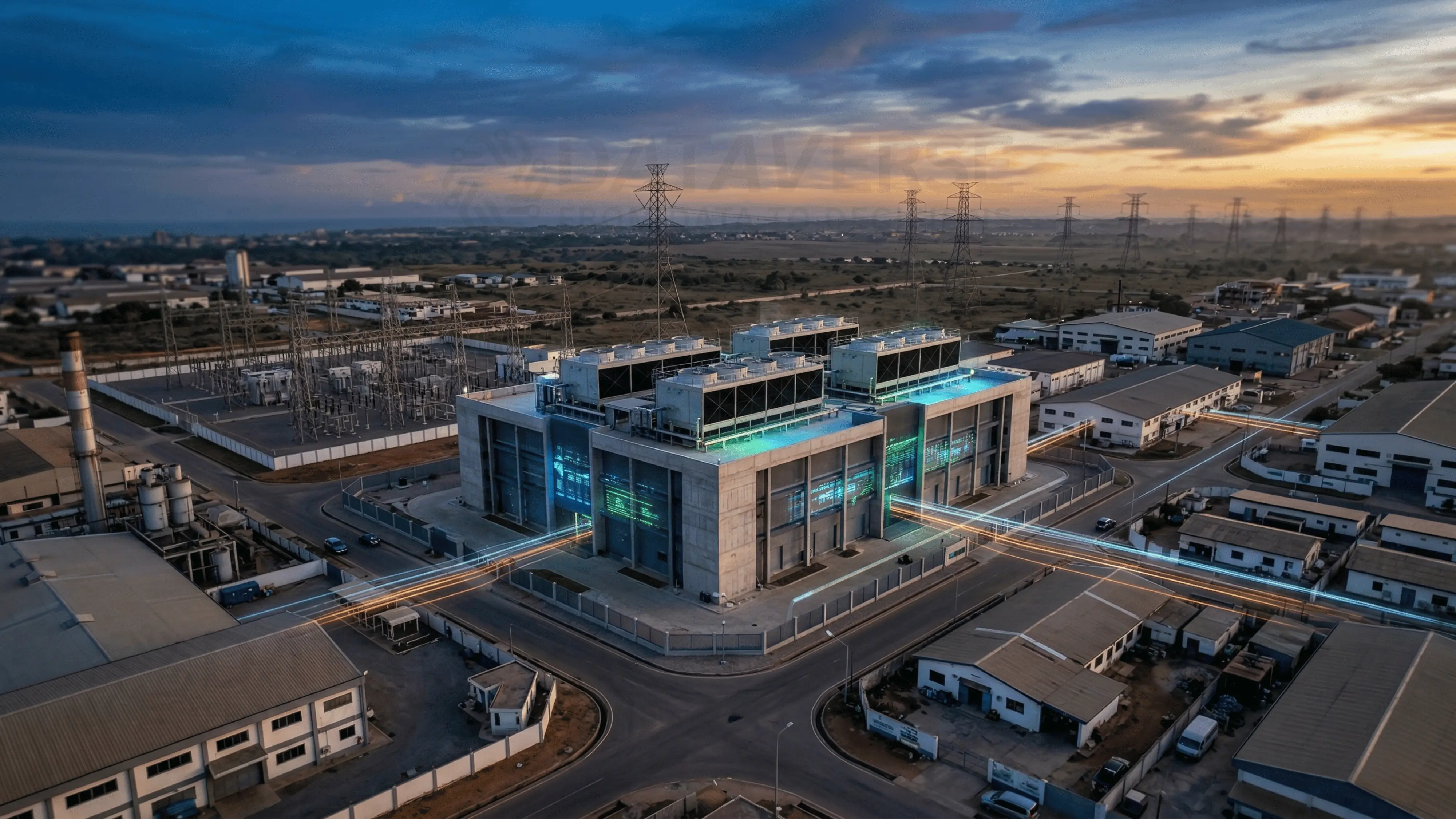
This matters because serious AI isn’t just about apps and algorithms; it is built on three physical pillars: the foundation (servers and storage), the life support (power and cooling), and the nervous system (networks and connectivity). Despite being home to 20% of the world’s population, Africa’s data centre capacity is on the “back-foot” (Mzekandaba, 2026), accounting for less than 1% of global capacity (ADCA, 2026). To achieve real independence, the continent must own the physical foundations of technology: the buildings (data centres) and the specialized hardware (GPUs) housed within them.
The Physical Reality of “The Cloud”
The “cloud” is not a weightless entity; it is a warehouse of computers consuming megawatts of power. Africa’s share of this physical infrastructure currently stands at 360 MW (0.36 GW) of active capacity (ADCA, 2026). To bridge the gap between current supply and actual need, McKinsey & Company (2025) projects that Africa will require an investment of $10 billion to $20 billion to reach a 2.2 GW target by 2030.
Because the continent lacks sufficient localized “compute,” digital traffic is subject to “tromboning.” This is a phenomenon where “intra-African digital traffic routinely travels out of the region to Europe before returning” (D4D Hub, 2025). This is the invisible friction slowing down African AI, turning a millisecond process into a second-long wait. This inefficient routing doesn’t just increase latency; it inflates costs and makes real-time AI processing nearly impossible (Cloudflare, 2026).
Furthermore, local realities amplify the challenge. In Ghana, frequent “dumsor” power outages disrupt tech operations, while South Africa’s rolling “load-shedding” similarly disrupts uptime. By 2030, demand is projected to rise 3.5 to 5.5 times (McKinsey & Company, 2025). Without this “full stack” of servers, cooling, and fibre, the dream of digital sovereignty remains constrained by a dependence on foreign operators.
The Financial Drain: Paying in Dollars for Local Data
Relying on foreign “hyperscalers” like Amazon Web Services (AWS), Microsoft Azure, and Google Cloud creates a structural “forex drain” (Mzekandaba, 2026). African startups are forced to pay for critical computing power in US Dollars, a cost that becomes unsustainable when local currencies depreciate.
In markets like Nigeria, where currency devaluation has been aggressive, this creates a “startup killer” environment. When the Naira or Cedi drops, the cost of hosting an AI model stays the same in USD, effectively doubling or tripling the operational burn rate overnight. This has forced a growing number of Nigerian startups to seek local alternatives just to survive (Techpoint, 2026).
The Power Elephant: The Electricity and Cooling
If data is the fuel for AI, then electricity is the air it breathes. A single AI inference query, the process of the model “thinking” to provide an answer, requires significantly more power to function than a standard Google search. This creates a systematic barrier for Africa: how can the continent build the “smart” technology of the future when 600 million people still lack basic electricity (World Bank & International Energy Agency [IEA], 2024)?
When the grid fails, tech companies rely on expensive diesel generators, making AI operations in Africa approximately twice as expensive as in Europe or America. In Ghana, unpredictable “dumsor” blackouts have shown to significantly erode the profitability and production of small firms (World Bank, 2024), while South Africa’s history of ‘load-shedding’ remains a persistent threat to the uptime required for a modern digital economy (Journal of Electrical Systems, 2025).
In tropical climates, cooling can account for nearly 40% of a data centre’s energy bill (Schneider Electric). Because grids are often “only marginally sufficient,” the high cost of cooling makes local hosting a financial struggle. To combat this, new facilities are beginning to pilot liquid cooling and direct-to-chip technologies, but without stable, affordable power, African AI will remain a “software dream” dependent on foreign plugs and foreign grids.
The Sovereignty Mandate
The Legislative Paradox
For Africa, digital sovereignty cannot be achieved through a mobile app or a clever line of code. It requires an “Infrastructure-First” mindset. Africa must move from being “digital tenants” paying rent to foreign providers to becoming “digital landlords,” controlling the facilities housing the stories, languages, solutions, and data.
However, a “Legislative Paradox” is emerging. Some nations are passing strict “Data Localization Laws” that mandate citizen data stay within national borders (African Business, 2025). The irony is that these laws are practically toothless if the country physically lacks the Tier III or IV data centres required to host that data securely. According to Africa Data Centres Association (2026), while over 40 countries have enacted data laws, the continent’s tiny share of global capacity (0.6%) means most data is still stored offshore. Investment must flow into the “full stack.” You cannot legislate data residency if you do not have the real estate. Without the concrete on the ground, these laws simply force local companies into a corner: break the law by using a stable foreign cloud, or risk data loss on an unstable local one. It is not enough to train software developers if they have no local servers to deploy their models on. Strengthening data protection laws (D4D Hub, 2025) ensures that African citizen data is not only hosted on the continent but is protected by African regulations. Furthermore, physical ownership must be matched by legal sovereignty, ensuring that the next generation of African AI is “Made in Africa, Hosted in Africa, and Powered by Africa.”
The Local Reality: Four Hubs, Four Stories
The “Infrastructure Question” looks different depending on where you stand. While the continent is growing, capacity is concentrated in four major hubs:
South Africa (The Giant): South Africa remains the most mature market, hosting approximately one-quarter of the continental total of data centres (Ecofin/Intelpoint, 2025). It is the gateway for global players like AWS and Microsoft, but growth is challenged by energy instability of the national grid.
Nigeria (The Challenger): The hub for West Africa is seeing a massive influx of capital. Equinix, a global leader, recently committed $22 million to its new Lagos (LG3) facility. This AI-oriented data centre with 12MW of capacity designed to bolster data sovereignty is a direct response to the need for local “compute” and represents the start of the $10B–$20B scale-up required for the region.(Data Centres Africa, 2025). Nigeria’s market is projected to reach 279.4 MW by 2030 (Connecting Africa, 2025).
Kenya (The Green Frontier): Positioning itself as the leader in sustainable compute. Through a partnership with G42 and Microsoft, the country is developing a geothermal-powered data centre with an initial capacity of 100 MW, scaling toward a staggering 1 Gigawatt (G42/Microsoft, 2024-2026).
Ghana (The Precision Market): In March 2026, Ghana achieved a 75.5 rating on the Fitch Solutions Digital Readiness Risk Index, outperforming regional peers like Nigeria (74.4) and Kenya (72.4). Despite “dumsor” (infrastructure constraints), Ghana is focusing on specialized innovation, evidenced by the PAIX - Ghana 1.2 MW facility commissioned in Accra. By positioning itself as a highly connected, carrier-neutral gateway, Ghana is proving that even mid-sized markets can carve out a “precision” niche in the continental AI supply chain.
The Path of Ownership: A Concrete Strategy
To move from a position of strength, African leadership must adopt a blueprint that treats data centres as critical national infrastructure:
Energy-First Policies: Providing dedicated, renewable power grids for tech hubs to eliminate the cost of “dumsor” and “load-shedding.”
Sovereign Data Clouds: Developing state-backed or regional data centres to host sensitive public data locally, ensuring it stays under African jurisdiction and is not subject to foreign surveillance.
Regional Integration: Strengthening local Internet Exchange Points (IXPs) to end the “tromboning” (D4D Hub, 2025) of our traffic through Europe.
Build Edge and Energy-Linked Infrastructure: Incentivizing the smaller “edge” facilities located closer to the user, are paired with dedicated renewable energy. By creating “energy-secure” tech islands, we protect our digital foundation from the broader instability (Xalam Analytics, 2024).
Carrier-Neutral Facilities: To lower costs, domestic facilities must remain carrier-neutral. Avoiding telecom monopolies and forcing interconnection drives down internet prices and ensures that “the cloud” remains an open platform.
The “Power Vampire” and the Future
In Accra, the struggle for sovereignty is a daily battle against the “AI power vampire.” High-performance computers are energy-hungry; they never sleep and require constant cooling. Success for local providers, depends entirely on power stability, switching to industrial generators directly inflates operational costs, making it more expensive to host a startup in Ghana than in markets with stable grids.
We must reframe AI sovereignty. It is not just about who writes the most clever algorithm; it is about who owns the servers, the cables, and the substations. Digital independence is a physical reality. If Africa does not own the hardware, Africa does not own the future (D4D Hub, 2025). By prioritizing “power-for-data” and owning the concrete foundations of our digital world, the continent can finally move from being a digital tenant to a digital landlord of its future.
However, the path forward for Ghana and the continent at large requires more than just policy or high digital readiness scores. True sovereignty is built “cable by cable and server by server.” To ensure that the next generation of African AI serves African people, the investment must shift from the “software dream” to the “concrete reality.” Only then can we ensure that the tools of the future are not just consumed in Africa, but are truly born, housed, and powered there.
Key Takeaways:
- The Hardware Reality of AI - rue digital sovereignty isn't achieved by writing clever algorithms; it requires owning the physical foundation. If Africa doesn't own the servers, cables, and data centers, it doesn't own its digital future.
- The Forex Drain - Relying on foreign cloud giants like AWS and Azure forces African startups to pay for essential computing power in US Dollars. When local currencies devalue, operational costs skyrocket, turning the cloud into a "startup killer."
- The Energy Bottleneck - AI is incredibly power-hungry. Without stable, dedicated energy grids, the reliance on expensive diesel generators and the high cost of cooling will continue to throttle the continent's tech ecosystems.
- The Legislative Paradox - Passing strict "Data Localization Laws" to keep citizen data onshore is practically toothless if a country lacks the physical Tier III/IV data centers required to actually host that data securely. You can't legislate residency without the real estate.