
 What Would Nkrumah's Vision Look Like in the Age of AI?
14 March 2026
Data Ecosystem and Policy
abena-agyeiwaa
Kwame Nkrumah
Artificial Intelligence
Pan-Africanism
Data Colonialism
AfCFTA
Ghana Tech Policy
KNUST
What Would Nkrumah's Vision Look Like in the Age of AI?
14 March 2026
Data Ecosystem and Policy
abena-agyeiwaa
Kwame Nkrumah
Artificial Intelligence
Pan-Africanism
Data Colonialism
AfCFTA
Ghana Tech Policy
KNUST
What Would Nkrumah's Vision Look Like in the Age of AI?
Kwame Nkrumah warned that political freedom is meaningless if a nation cannot control its industry and science. Sixty years later, as Africa faces 'data colonialism' and relies on foreign compute power, how do we translate his vision of self-determination into the age of artificial intelligence?
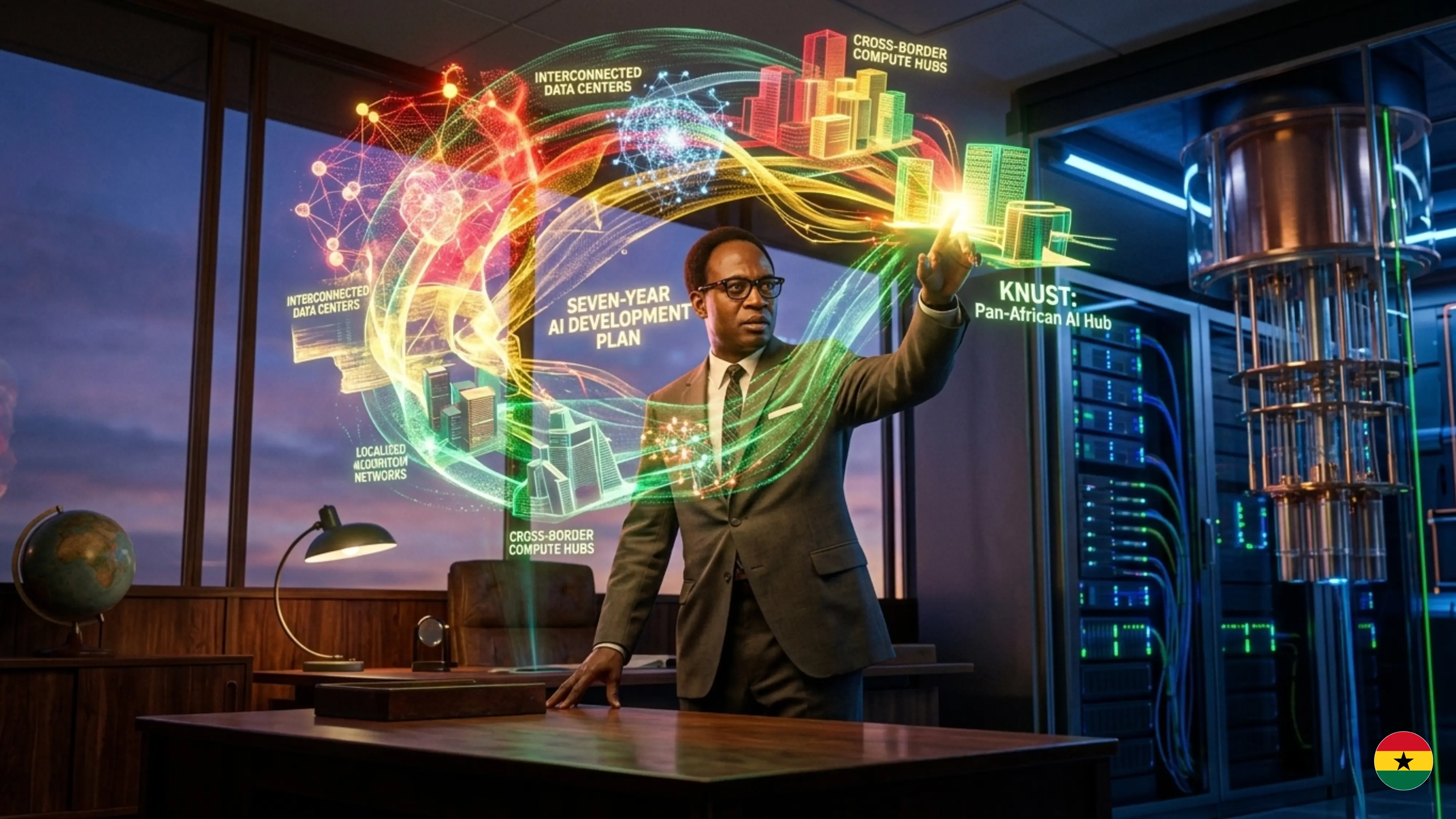
Picture this: it is 1964. Ghana is buzzing with optimism. The Akosombo Dam is rising majestically over the Volta River, symbolizing more than hydroelectric power. It represents possibility. At the center of this national moment stands Kwame Nkrumah, bowtie perfectly in place, imagining a future where Ghana would not simply be politically independent, but intellectually, technologically and economically sovereign. Political freedom, he warned repeatedly, would mean very little if a nation could not control its industry, science and production. This conviction was not merely rhetorical. In his 1963 Address to the Ghana Academy of Sciences, Nkrumah argued that the newly independent African state had to deliberately cultivate scientific and technological capacity or risk slipping back into dependency. Independence without technological competence, he believed, would leave Africa vulnerable to external economic control. More than sixty years later, that warning feels remarkably contemporary. Fast forward to 2026. Instead of turbines and factories, the engines of global power increasingly revolve around data centers, artificial intelligence systems and cloud infrastructure. Nations that dominate these technologies shape markets, influence security systems and control the production of knowledge. In this environment, a compelling question emerges: what would Nkrumah’s vision of self-determination, industrialization and Pan-African unity look like in today’s AI-driven world?
From Akosombo to AI: Infrastructure Determines Destiny
Nkrumah’s Ghana understood something fundamental: infrastructure determines national destiny. The Akosombo Dam was never just an engineering project. It was a strategic intervention into Ghana’s economic future. Reliable electricity would enable industries to function, factories to expand and entirely new sectors to emerge. Energy infrastructure therefore became the foundation of industrial independence. In the twenty-first century, the infrastructure determining economic power has expanded beyond electricity to include digital networks and computational capacity. Data centers, fiber optic systems and high-performance computing now form the backbone of the global digital economy. Artificial intelligence depends heavily on such infrastructure. Training advanced AI systems requires enormous storage, computational resources and technical expertise. Resources concentrated in a small number of technologically advanced countries and corporations. Where this infrastructure does not exist locally, countries must rely on foreign platforms to build and deploy AI tools. Today, dependence on AI ecosystems built by companies such as OpenAI, Google and Amazon Web Services risks becoming the modern equivalent of relying on imported industrial goods. The dependency may now be digital rather than mechanical, but the structural implications remain familiar. This creates a new form of technological dependence. African countries generate enormous volumes of valuable data through mobile finance, health systems, agriculture and governance. Yet much of the computational power needed to transform this data into economic value remains located elsewhere. Seen through Nkrumah’s lens, this raises a strategic question. If Akosombo represented control over energy as the basis of industrial development, then data centers and AI infrastructure increasingly represent control over knowledge production in the digital age.
Scientific Institutions and National Capacity
Nkrumah’s development vision placed extraordinary emphasis on scientific institutions. Universities and research centers were not simply educational spaces in his thinking; they were instruments of national transformation. The development of the Kwame Nkrumah University of Science and Technology reflected this philosophy. Rather than reproducing colonial education models focused on administrative training, KNUST was intended to produce engineers, technologists and applied scientists capable of supporting industrialization. Similarly, the establishment of the Ghana Atomic Energy Commission reflected a bold attempt to position Ghana within advanced scientific research. In the 1960s, nuclear science represented technological modernity. By investing in this sector, Nkrumah was signaling that Ghana should not be excluded from global scientific advancement. These investments reflected a powerful strategic idea: nations that produce knowledge enjoy greater autonomy than those that merely consume it. That same principle applies directly to artificial intelligence today. Universities, research institutes and technical laboratories remain essential to technological independence. If Ghana’s scientific institutions helped nurture industrial ambition in the twentieth century, they could play an equally important role in developing AI expertise today. Developing domestic expertise in machine learning, data science and computational engineering would allow Ghana not only to adopt AI tools but to help shape them.
Continental Unity versus Digital Fragmentation
Nkrumah’s thinking was never confined to Ghana. He consistently argued that Africa’s long-term prosperity depended on continental unity. Fragmented African states, he believed, would remain economically vulnerable. Individually they might struggle, but collectively they could pool resources and negotiate from a position of strength. This argument has clear relevance today. Africa currently operates as dozens of separate digital markets, each with different regulations, infrastructure gaps and policy priorities. For global technology firms, this fragmentation makes it easier to negotiate country by country rather than engage Africa as a unified technological bloc. The African Continental Free Trade Area presents an opportunity to change this. By encouraging digital trade integration and regulatory harmonization, it could help build a continental digital economy. Such integration could support shared data infrastructure, collaborative research and larger digital markets capable of sustaining competitive technology firms. From an Nkrumah perspective, this would represent a digital continuation of the Pan-African project.
Scientific Socialism in the Digital Age
Nkrumah’s economic philosophy, often described as scientific socialism, emphasized strategic state coordination in technological transformation. His Seven Year Development Plan represented an ambitious attempt to coordinate infrastructure, education and industrial growth within a long term national strategy. Its goal was clear: to transform Ghana from a commodity exporter into an industrial producer. A similar level of strategic thinking may be required in the AI sector today. This raises a necessary policy question: do we currently have the equivalent of a SevenYear AI Plan capable of positioning Ghana as a technological producer rather than simply a consumer of digital innovation? Artificial intelligence has the potential to transform sectors ranging from agriculture and healthcare to urban planning and climate resilience. But such transformation requires policy direction, sustained investment and institutional coordination. At the same time, the digital age presents governance risks less visible in Nkrumah’s era. AI technologies can enable surveillance, predictive profiling and behavioral monitoring. Without safeguards, technological centralization could create risks for civil liberties. Modern technological governance therefore requires balancing strategic ambition with ethical oversight.
Neo-Colonialism and Data Colonialism
Perhaps Nkrumah’s most enduring intellectual contribution remains his analysis of neo-colonialism. In Neo-Colonialism: The Last Stage of Imperialism, he argued that political independence did not automatically produce genuine sovereignty. Economic systems could remain structured in ways that preserved external dominance. Today, scholars such as Nick Couldry and Ulises Mejias have extended this analysis through the concept of data colonialism, while African digital governance thinkers including Opoku-Agyemang have contributed to debates about digital sovereignty. Their work explores how global technology firms extract value from data generated worldwide in ways resembling earlier extractive systems. Although data may be produced locally, the economic benefits often accumulate elsewhere. Artificial intelligence intensifies this pattern because the countries and corporations controlling data infrastructure, computing power and advanced research capabilities occupy the most influential positions in the emerging digital order. From this perspective, technological dependency today may increasingly resemble the structural economic dependencies that concerned Nkrumah decades ago.
Ghana’s Current Posture: Opportunity and Gap
Ghana today possesses meaningful foundations for digital development. Its universities continue to produce skilled graduates, while national institutions provide oversight for emerging technologies. Organizations such as the Cyber Security Authority play an important role in protecting national digital systems and strengthening cyber resilience. Yet much of Ghana’s current posture emphasizes defensive capacity rather than technological expansion. Protection is essential, but technological sovereignty ultimately depends on the ability to build, innovate and produce. The more fundamental challenge lies in strengthening research ecosystems, industrial innovation capacity and the infrastructure necessary for advanced technological development. In this respect, the contrast with the scientific investments of the Nkrumah era is striking. His administration treated scientific infrastructure as a cornerstone of national transformation. That same spirit of strategic ambition may prove essential as Ghana and other African countries position themselves within the global AI economy. Several important lessons emerge from revisiting Nkrumah’s ideas in this technological context: Technological sovereignty today must extend beyond political independence to include ownership of digital infrastructure and computational capability. Nations that invest seriously in scientific education and AI research strengthen their ability to shape their futures rather than simply adapting to systems built elsewhere. Africa’s competitiveness in the digital economy may depend heavily on continental cooperation just as earlier generations believed political unity was essential. Data may become the defining strategic resource of this century, making domestic AI capacity critical to avoiding new forms of dependency. Above all, Nkrumah’s example reminds us that national transformation begins with intellectual ambition and the courage to think long term about technological change. Ultimately, the technologies may have changed, but the strategic challenge Nkrumah identified remains consistent. Political independence was never the destination. It was the starting point. In the twentieth century, national strength was built through dams, factories and industrial systems. In the twenty first century, it increasingly depends on data, algorithms and computational power. The instruments have changed. The strategic question has not: Who controls the technology that shapes the future?
Key Takeaways:
- True sovereignty means owning data centers and computational capacity, not just achieving political independence.
- Relying on foreign platforms like OpenAI or Google risks a new dependency where local data builds external wealth.
- Nations must invest in domestic AI research to shape their own technological futures rather than merely adapting to foreign systems.
- Africa's digital competitiveness relies heavily on continental cooperation to overcome fragmented markets.
- We need ambitious, coordinated state planning-a "Seven Year AI Plan"-to transition from technology consumers to producers